
- 28/07/2026
- Dr. Vikas Pakhare
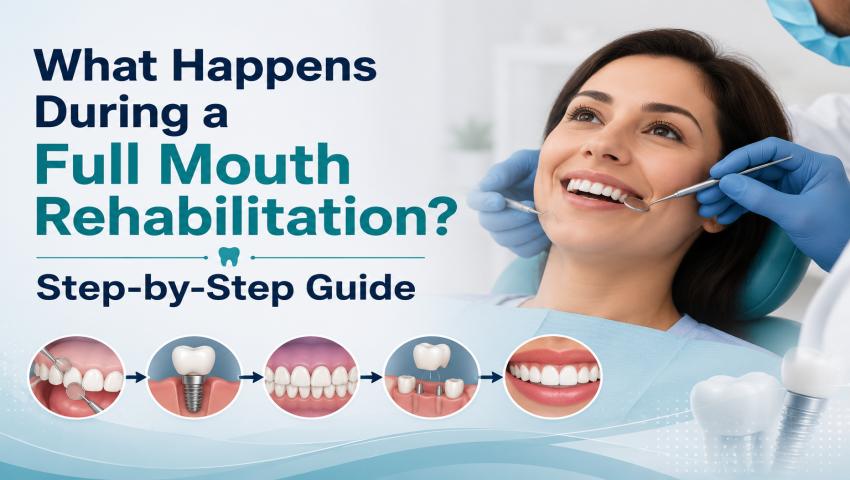
What Happens During a Full Mouth Rehabilitation? Step-by-Step Guide
If you’ve been living with broken teeth, chronic jaw pain, or years of unfinished dental work, you may have heard your dentist mention “full mouth rehabilitation” as a solution. At Goodfaith Dental care in Hinjewadi, Pune, patients from across Hinjewadi and Wakad often ask Dr. Vikas Pakhare, a Best Dentist in Hinjewadi, the same question: What Happens During Full Mouth Rehabilitation? and how long does it take?
This guide walks through the entire process step by step, so you know exactly what to expect before you sit in the dental chair.
What Is Full Mouth Rehabilitation?
Full-mouth rehabilitation, sometimes called a full-mouth reconstruction procedure or complete-mouth restoration treatment, is a comprehensive treatment plan that restores every tooth to full health and function. Unlike a single filling or crown, it looks at your bite, gums, jaw joints, and appearance together, instead of treating each problem in isolation.
It usually combines several procedures into one coordinated journey rather than a series of disconnected visits — implants where teeth are missing, root canals where infection has set in, crowns or bridges to rebuild damaged teeth, and sometimes clear aligners to correct alignment before final restorations go in.
Who Needs Full Mouth Rehabilitation?
This isn’t a treatment everyone needs. It’s typically recommended for patients who have:
- Multiple missing or badly broken teeth
- Severe tooth wear from grinding (bruxism)
- Chronic jaw pain or TMJ (jaw joint) issues
- Advanced gum disease affecting several teeth
- A mix of old, failing crowns, fillings, and root canals
- Bite problems that affect chewing, speech, or facial appearance
If you’re unsure whether your case qualifies, a consultation with an experienced Dental surgeon in Hinjewadi is the best place to start.
Step-by-Step: What Happens During Full Mouth Rehabilitation?
Step 1
Comprehensive Oral Examination and Diagnosis:
Every rehabilitation begins with a thorough clinical evaluation. Dr. Vikas Pakhare examines your teeth, gums, jaw joints, and bite alignment, and reviews digital X-rays or a CBCT scan where needed. This step identifies the root cause of your dental issues rather than just treating what’s visible on the surface.
Gum health is checked closely at this stage too, since untreated periodontal disease can affect how well implants and crowns hold up later. This is where the input of an experienced Periodontist in Hinjewadi becomes essential to getting the plan right from the start.
Step 2
Treatment Planning:
Once the diagnosis is complete, a customised plan is built around your specific needs. It outlines which teeth need extraction, which need root canal therapy, which areas need implants, and how your bite will be corrected. At GoodFaith Healthcare, this plan is explained in plain language, along with a realistic timeline and cost estimate, so there are no surprises later.
Step 3
Preparatory or Foundational Treatments:
Before any restorative work begins, the mouth needs a healthy foundation. This phase may involve:
- Extracting teeth that can’t be saved
- Deep cleaning to treat gum inflammation
- Root canal therapy for infected or damaged teeth
- Minor oral surgery to prepare the jawbone for implants
This is one of the most important stages of the whole process — skipping it is one of the main reasons implants or crowns fail later on.
Step 4
Bone Grafting and Implant Placement (If Needed):
If teeth have been missing for a while, the underlying jawbone often shrinks, and bone grafting may be needed to create a stable base. Once the site is ready, implants are surgically placed. Precise digital planning at this stage helps position each implant for long-term stability and a natural-looking result.
Implants generally need a healing period of a few months before the next phase can begin, since the implant has to fuse with the jawbone — a process called osseointegration.
Step 5
Restorative Phase — Crowns, Bridges and Prosthetics:
Once implants have healed, or once natural teeth have been treated, the restorative phase begins. A prosthodontist designs and fits crowns, bridges, veneers, or dentures to rebuild the shape, strength, and appearance of your teeth. Every restoration is customised to match your natural bite and facial structure rather than following a one-size-fits-all approach.
Step 6
Bite Correction and Alignment:
A rehabilitated mouth needs to function well, not just look good. Your dentist checks how your upper and lower teeth meet and makes fine adjustments where needed. In some cases, clear aligners are recommended alongside restorative work to correct minor misalignment before the final restorations are placed.
Step 7
Aesthetic Finishing:
For patients who want their new smile to look as good as it feels, additional cosmetic steps such as professional teeth whitening or minor contouring may be included at the end, giving the restored teeth a uniform, natural shade.
Step 8
Follow-Up and Maintenance:
Full mouth rehabilitation doesn’t end when the last crown is placed. Regular follow-up visits are scheduled to monitor healing, check implant stability, and make sure your bite stays comfortable. Routine cleanings and checkups after that help the results last for years.
How Long Does Full Mouth Rehabilitation Take?
Timelines depend on how complex your case is. Simpler cases involving crowns and root canals can often be completed in 4 to 8 weeks, while cases that involve implants and bone grafting can take 4 to 8 months, largely because of the healing time implants require. During your consultation, Dr. Vikas Pakhare will give you a personalised timeline based on your specific needs, not a generic estimate.
Is Full Mouth Rehabilitation Painful?
Most patients are relieved to find this process far more manageable than they expected. Local anaesthesia is used during surgical steps like extractions and implant placement, and any soreness afterwards is usually mild and manageable with prescribed medication. Spacing each phase out to allow proper healing also helps keep discomfort to a minimum throughout treatment.
Cost of Full Mouth Rehabilitation in Pune:
Cost depends on the number of teeth involved, whether implants and bone grafting are required, and the type of restorations chosen — crowns, bridges, or dentures. Because every case looks different, GoodFaith Healthcare provides a detailed, transparent cost breakdown after your initial examination, so you can plan your treatment with real numbers instead of guesswork.
Why Choose GoodFaith Healthcare for Full Mouth Rehabilitation in Hinjewadi?
Choosing the right clinic matters as much as the treatment plan itself. A few things set GoodFaith Healthcare apart:
- Led by Dr. Vikas Pakhare, a dental surgeon experienced across implants, prosthodontics, and periodontal care
- In-house expertise spanning oral surgery, pedodontics, and cosmetic dentistry, so you’re not shuttled between multiple clinics
- Modern diagnostic technology for accurate treatment planning
- Clear, step-by-step communication at every stage of treatment
- A trusted dental clinic serving patients across Hinjewadi, Wakad, and nearby areas of Pune
Whether you’re looking for the best dentist for full mouth rehabilitation in Hinjewadi, or simply exploring your options as a patient in Wakad, GoodFaith Healthcare is built around guiding you through a smooth, well-planned recovery from start to finish.
Ready to Restore Your Smile?
If missing, damaged, or worn-out teeth are affecting your confidence and daily life, don’t wait for the problem to get worse. Book a consultation for Full mouth rehabilitation with Dr. Vikas Pakhare at GoodFaith Healthcare today, and take the first step toward a fully restored, healthy smile.
Frequently Asked Questions:
It involves a full diagnosis, treatment planning, preparatory procedures like extractions or root canals, implant placement where needed, restorations such as crowns or bridges, bite correction, and ongoing maintenance.
Depending on complexity, treatment can take anywhere from 4 weeks to several months, especially when dental implants and bone grafting are involved.
Patients with multiple missing or damaged teeth, severe wear, jaw pain, or advanced gum disease are typically good candidates.
Most steps are performed under local anaesthesia, and any post-procedure discomfort is usually mild and manageable with medication.
Costs vary based on the number of teeth treated and the procedures involved. GoodFaith Healthcare provides a personalised quote after examination.